Heads up: The skin-care and wellness uses in this article are for general informational purposes only. They are not medical or dermatological advice. If you have a skin condition, chronic digestive issue, or any health concern, consult a qualified healthcare provider before trying any home remedy.
Walk through any wellness forum or natural-beauty blog and you will eventually land on a recipe that combines baking soda and honey. The two ingredients show up together in face masks, throat soothers, hair treatments, and honey cakes alike. Some of those uses are grounded in solid science. Others are supported mostly by tradition and wishful thinking.
This guide covers every practical use for baking soda and honey together — culinary, cosmetic, and wellness — explains what the chemistry and published research actually support, and gives you clear recipes for the combinations worth trying. Nothing is oversold; if the evidence is weak, you will know.
Table content
- 1 Why These Two Ingredients Get Paired
- 2 What Each Ingredient Actually Brings
- 3 In the Kitchen: Where This Pairing Really Shines
- 4 Baking Soda and Honey for Skin
- 5 Baking Soda and Honey for Sore Throat and Cough
- 6 Baking Soda and Honey for Scalp and Hair
- 7 What the Research Actually Supports: A Practical Summary
- 8 Safety Considerations
- 9 Common Questions
- 10 Key Takeaways
Why These Two Ingredients Get Paired
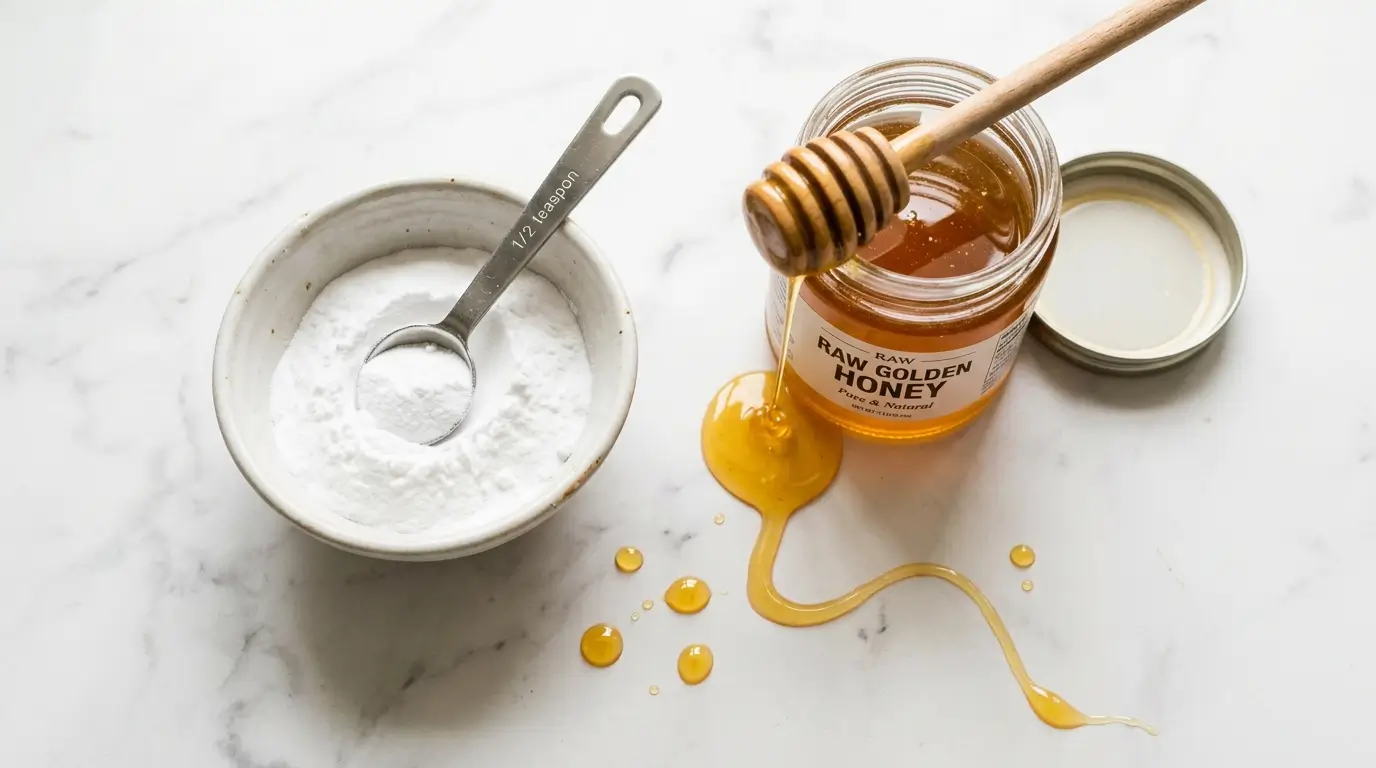
The pairing has intuitive logic. Baking soda (sodium bicarbonate) is alkaline, mildly abrasive, and chemically reactive. Honey is mildly acidic, viscous, and packed with antimicrobial compounds. In folk remedy tradition, they represent complementary forces: baking soda cuts and neutralizes; honey soothes and protects.
There is also a simple culinary chemistry behind the combination that actually does work predictably. Honey’s mild acidity reacts with baking soda’s alkalinity to produce carbon dioxide bubbles, giving quick breads and cakes lift without yeast. That reaction is real, reliable, and used in kitchens all over the world. The wellness applications are more variable in quality — which is exactly why it pays to understand each ingredient on its own before mixing them.
What Each Ingredient Actually Brings
Baking Soda
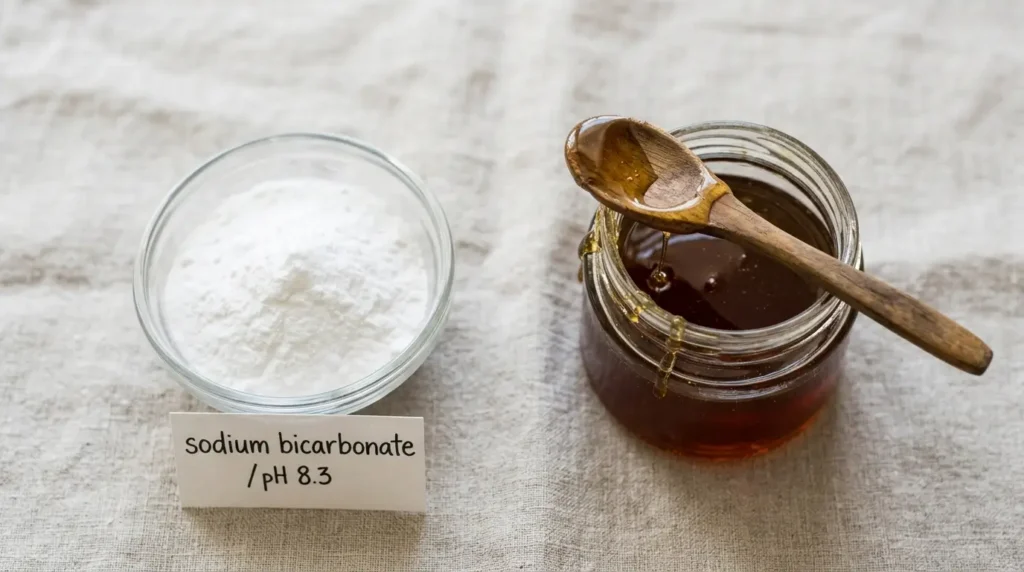
Baking soda is pure sodium bicarbonate (NaHCO₃), a naturally occurring mineral compound. Its pH sits around 8.3 — notably alkaline. That alkalinity drives most of its useful properties:
- Leavening agent: It reacts with acidic ingredients (honey, buttermilk, vinegar, lemon juice) to produce carbon dioxide gas, which causes batters and doughs to rise.
- Mild abrasive: The fine crystal structure makes it a gentle physical exfoliant, which is why it appears in teeth cleaning and skin scrub recipes.
- Odor neutralizer: Baking soda chemically reacts with and neutralizes acidic odor molecules — the same principle behind refrigerator and carpet deodorizing.
- Antacid: In small measured amounts, sodium bicarbonate neutralizes excess stomach acid, which is why it appears in numerous over-the-counter antacid formulations.
For a complete breakdown of sodium bicarbonate’s chemistry and uses, see our guide to what baking soda is and how it works.
Honey
Raw honey is a complex mixture of sugars (primarily fructose and glucose), water, amino acids, vitamins, minerals, and a suite of bioactive compounds. Its pH ranges from approximately 3.4 to 6.1 — mildly acidic, which is the opposite of baking soda. Its most relevant properties for home use:
- Antimicrobial: Honey’s low water activity, acidic pH, enzymatic hydrogen peroxide production, and bee-derived defensin-1 peptide create a hostile environment for many bacteria and fungi. This is not folklore — medical-grade honey wound dressings are a legitimate clinical product supported by peer-reviewed research.
- Humectant: Honey draws and retains moisture, making it an effective skin-conditioning agent in cosmetic formulations.
- Anti-inflammatory: Phenolic acids and flavonoids in honey show anti-inflammatory activity in laboratory and animal studies. Human trial evidence is more limited and varies considerably by condition.
- Cough suppressant: Multiple randomized controlled trials and a Cochrane systematic review support honey as a moderately effective treatment for acute cough in upper respiratory infections. The World Health Organization recognizes honey as a potential demulcent treatment for cough.
When baking soda and honey are combined in sufficient proportions, the acid-base contact produces a mild, short-lived fizz. The mixture quickly reaches equilibrium and the fizzing stops. The resulting paste or liquid is neither strongly acidic nor strongly alkaline.
In the Kitchen: Where This Pairing Really Shines
The culinary application of honey and baking soda is the most dependable use of the two, and the chemistry is unambiguous. Honey’s natural acidity activates baking soda in the same way as buttermilk, brown sugar, or lemon juice: the carbonic acid produced when sodium bicarbonate reacts with an acid decomposes into carbon dioxide and water, and the CO₂ bubbles create lift in the batter.
Classic recipes where this pairing works:
- Honey cake (a traditional Eastern European and Jewish recipe built around this exact reaction)
- Honey quick bread and honey oat loaf
- Honey-sweetened gingerbread (where honey provides both sweetness and the acid that activates the baking soda)
- Honey bran muffins
- Certain shortbread variations using honey as a partial sweetener
The practical ratio: A common starting point is ¼ teaspoon of baking soda for every 1 tablespoon of honey used as the primary acid in a recipe. Adjust based on the total acid content — if the recipe also includes buttermilk or lemon juice, reduce the baking soda accordingly, or you risk a soapy, over-neutralized flavor.
This is also why many traditional baking recipes that call for honey specify that no baking powder is needed — the honey itself provides the acid that makes baking soda work.
Baking Soda and Honey for Skin
Face Mask and Exfoliating Paste
Recipe:
- 1 tablespoon raw honey
- ½ teaspoon baking soda
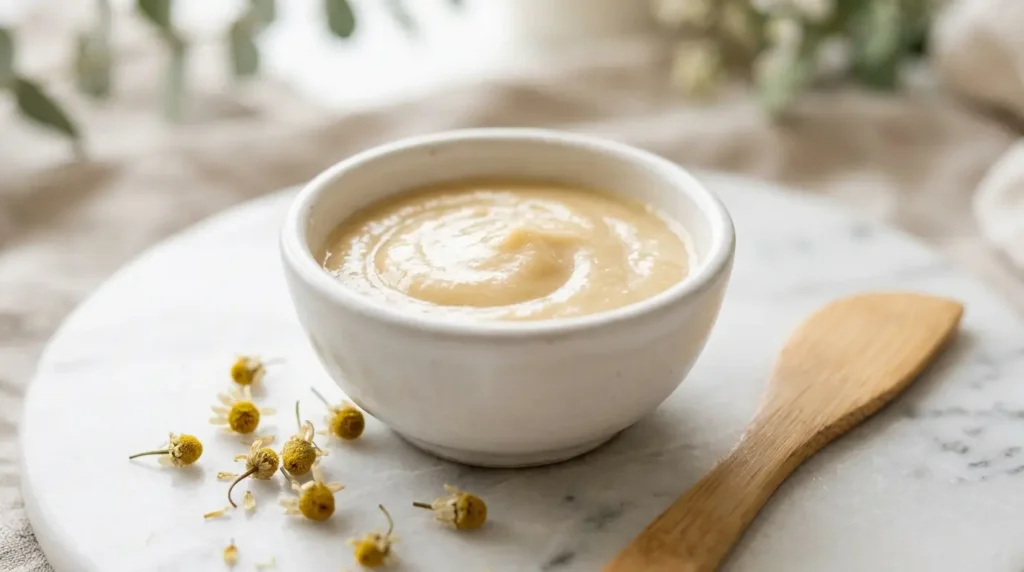
Mix into a smooth paste. Apply to clean, dry skin. Leave on for 5 minutes maximum. Rinse thoroughly with cool water. Follow immediately with a fragrance-free moisturizer.
What it actually does: Baking soda provides mild physical exfoliation via its fine crystal structure. Honey contributes antimicrobial action and helps prevent the mixture from becoming too abrasive. The combination can temporarily improve the appearance of congested pores and dull skin texture after a single use.
The honest limitation: Baking soda has a pH of 8.3. Healthy skin’s acid mantle sits around pH 4.5 to 5.5. Repeated alkaline exposure disrupts the skin’s natural barrier, which can lead to dryness, increased sensitivity, and paradoxically, more breakouts — particularly in people with oily or acne-prone skin. Use this mask at most once per week and always moisturize afterward. If you have eczema, rosacea, psoriasis, or active acne, patch test on your inner wrist 24 hours before applying to your face. Many dermatologists recommend skipping baking soda on the face entirely for sensitive skin types.
Skin Brightening Scrub for Rough Patches
Recipe:
- 1 tablespoon raw honey
- 1 teaspoon baking soda
Apply to elbows, knees, heels, or other areas with rough or thickened skin. Massage gently in circular motions for 60 seconds. Rinse and moisturize.
This is a straightforward physical exfoliation recipe. Baking soda’s abrasive crystals remove dead skin cells; honey softens the skin and reduces irritation from the scrub. Stick to thicker-skinned body areas rather than the face, and limit use to once or twice per week.
Baking Soda and Honey for Sore Throat and Cough

This is the wellness application with the strongest scientific basis — though most of that evidence belongs to honey, not baking soda.
Recipe:
- 1 tablespoon raw honey
- ¼ teaspoon baking soda
- 8 ounces warm (not boiling) water
Stir until dissolved. Drink slowly while warm.
What the evidence supports: Honey’s cough-suppressing and throat-soothing effects are backed by meaningful clinical data. A 2018 Cochrane review found that honey is more effective than diphenhydramine and similarly effective to dextromethorphan for relieving cough symptoms in children over 12 months. The WHO lists honey as a potential treatment for acute cough in upper respiratory infections. Baking soda’s role in this drink is different — it acts as a gentle antacid, neutralizing excess stomach acid that can aggravate throat irritation and post-nasal drip during illness. The two effects are complementary rather than synergistic.
One absolute safety rule: Never give honey to infants under 12 months old. The risk of infant botulism from spores that may be present in raw honey is real and serious. This applies regardless of how diluted or cooked the honey is.
This drink is a home comfort measure, not a treatment. If symptoms are severe, last more than ten days, or include a high fever or difficulty breathing, see a healthcare provider.
Baking Soda and Honey for Scalp and Hair
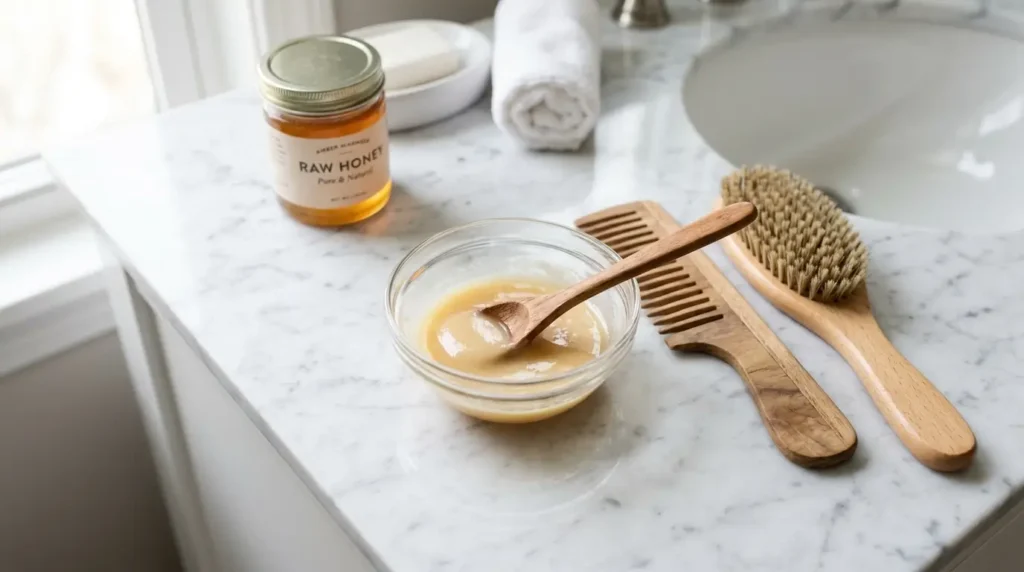
Recipe:
- 2 tablespoons raw honey
- 1 teaspoon baking soda
Apply to a damp scalp, concentrating on areas with product buildup. Massage gently for one to two minutes. Rinse thoroughly. Follow with conditioner on the lengths.
What it does: Baking soda is effective at dissolving and lifting product buildup — silicones, waxes, and residue from dry shampoo — because its alkalinity and mild abrasion physically dislodge deposits. Honey softens the scrubbing action and helps retain moisture on the scalp.
The important caveat: The scalp’s natural pH is around 5.5. Regular alkaline exposure from baking soda raises the pH of hair’s cuticle layer, causing the cuticle scales to swell and lift, which leads to frizz, dryness, and over time, breakage. Use this treatment occasionally — once a month at most — not as a routine clarifying step. It is not a replacement for a pH-balanced clarifying shampoo.
What the Research Actually Supports: A Practical Summary
| Use | Evidence | Verdict |
|---|---|---|
| Leavening in baking | Strong — established culinary chemistry | Works as designed; use confidently |
| Honey for cough/sore throat | Strong — multiple RCTs, Cochrane review, WHO | Honey earns this; baking soda adds antacid support |
| Honey’s antimicrobial properties | Strong — in vitro + wound care literature | Real; supports topical applications |
| Skin exfoliation (physical) | Moderate — mechanistic basis is sound | Works for occasional exfoliation; watch the pH risk |
| Scalp buildup removal | Moderate | Effective; use infrequently |
| Skin brightening / hyperpigmentation | Weak | Only mechanical exfoliation; no chemical lightening effect |
| Acne treatment | Weak | No clinical trials on this combination; honey’s antimicrobial properties are plausible support |
The pattern is consistent: honey brings the most meaningful, research-backed properties to most of these uses. Baking soda contributes abrasion, leavening, or pH buffering. The combination is additive — each ingredient doing its established job — rather than creating a new effect that neither could produce alone.
Safety Considerations
For skin use: Limit baking soda applications to once or twice per week at most. Always follow with a moisturizer. Never apply to broken, sunburned, inflamed, or freshly shaved skin.
For internal use: Baking soda increases dietary sodium intake, which is relevant for anyone managing hypertension, kidney disease, or heart failure. The ¼ teaspoon used in the sore throat drink (approximately 150 mg sodium) is well within safe limits for healthy adults but should be factored into daily intake for those on sodium-restricted diets. Do not take baking soda on a full stomach — the rapid CO₂ release can cause discomfort.
Honey allergy: Raw honey contains bee pollen proteins that can trigger allergic reactions in people with pollen sensitivities. If you have a known pollen allergy, consult your physician before using raw honey topically or internally.
For a similar look at how baking soda behaves with another common household ingredient, see our guide to baking soda and hydrogen peroxide: safe uses and recipes. The safety principles overlap in several ways.
Common Questions
Can you mix baking soda and honey together?
Yes. They are safe to combine and will fizz briefly as the acidic honey reacts with alkaline baking soda. The mixture stabilizes quickly and is suitable for culinary or topical use.
Does honey and baking soda lighten skin?
It provides mechanical exfoliation, which can temporarily improve the appearance of rough or uneven skin texture. There is no clinical evidence that it chemically reduces melanin production or reverses hyperpigmentation.
Is it safe to drink baking soda and honey water?
For healthy adults, yes — in the small amounts described here. The ¼ teaspoon of baking soda per glass is within normal antacid dosing limits. Do not use this drink daily long-term or exceed standard antacid dosage guidelines.
Key Takeaways
Baking soda and honey is a pairing that earns its reputation in specific contexts and falls short in others. In the kitchen, the acid-base leavening chemistry is real and reliable. For sore throats and cough, honey’s benefits are well-documented and baking soda adds reasonable antacid support. For skin and hair, the combination is useful for occasional physical exfoliation, but the risks of pH disruption are real and worth respecting — more is not better here.
Use each ingredient for what it genuinely does well, set realistic expectations, and you will get real results from this combination.
For a full look at every way baking soda pairs with other household ingredients — vinegar, lemon, peroxide, salt, and more — visit the complete baking soda combinations guide.
Also useful: our lemon and baking soda drink guide covers another popular wellness pairing with a similar evidence-first approach.
Medical disclaimer: This article is for general informational purposes and does not constitute medical, dermatological, or nutritional advice. Always consult a qualified healthcare provider before using any home remedy to address a health condition.