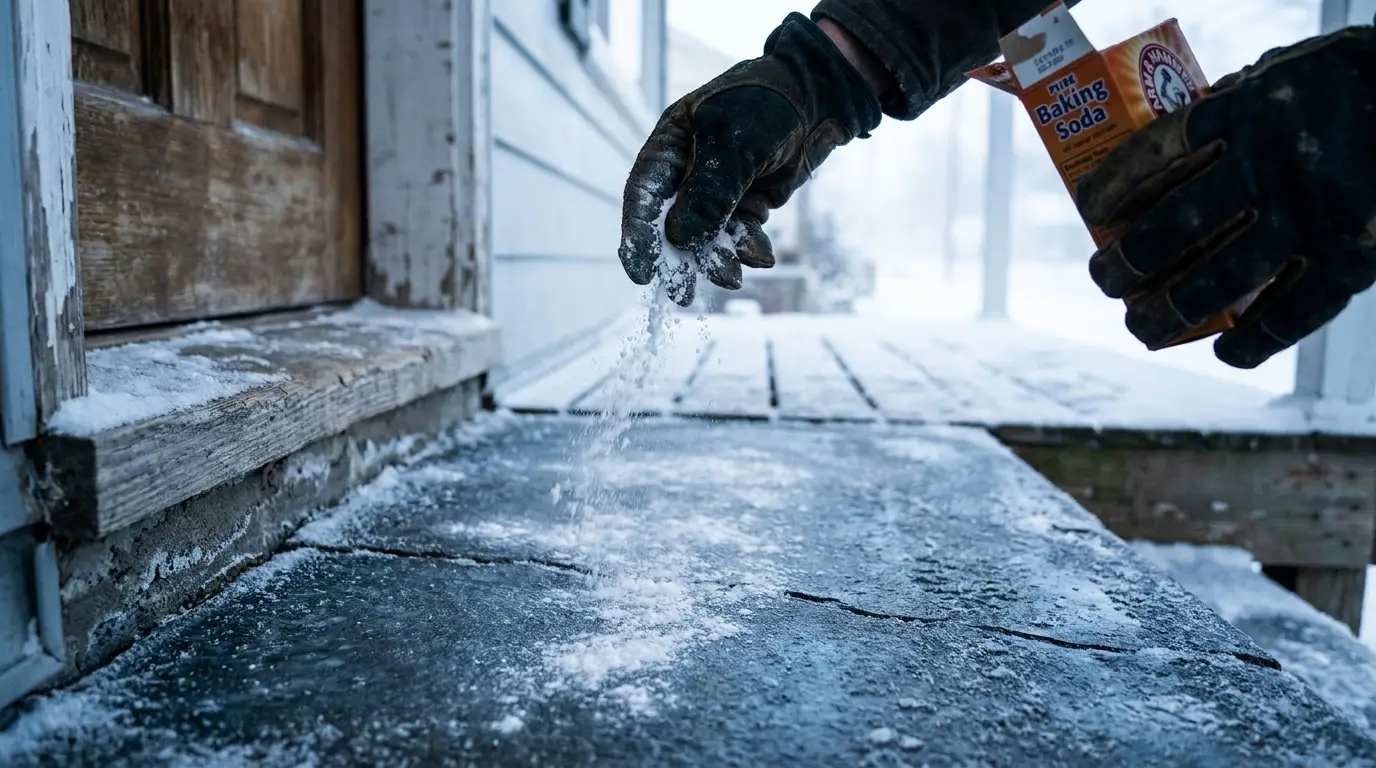
Yes — baking soda melts ice. It works through the same mechanism as rock salt and other commercial ice melters: dissolving in water lowers the freezing point of the solution, which prevents ice from reforming and gradually converts existing ice to slush. The honest qualifier is that it does this less effectively than rock salt, works best at temperatures close to freezing, and functions primarily as a surface traction agent below about −9°C (15°F). But for light ice near 0°C (32°F) — the most common situation on a sidewalk or step — baking soda does the job, and it does it more gently than the alternatives.
Table content
How ice melters work: freezing point depression
Any dissolved substance lowers the freezing point of water below 0°C — this is a fundamental colligative property of solutions, meaning it depends on the number of dissolved particles in the solution, not what those particles are. When you spread a soluble compound on ice, it absorbs moisture from the ice surface, dissolves, and creates a solution whose freezing point is lower than 0°C. That solution doesn’t refreeze at ambient temperatures near 0°C, and the heat exchange involved in the phase transition helps melt the surrounding ice.
The key variable is how many particles a substance releases per molecule when it dissolves. This determines the magnitude of the freezing point depression — more particles per molecule dissolved means a lower freezing point.
- Sodium chloride (rock salt) dissociates into two ions per formula unit: Na⁺ and Cl⁻. It’s highly soluble and effective down to about −9°C (15°F) before its melting action becomes negligible.
- Calcium chloride dissociates into three ions per formula unit: Ca²⁺ and two Cl⁻. It’s effective down to approximately −29°C (−20°F) and is the most powerful common ice melter available.
- Magnesium chloride dissociates into three ions and works to about −15°C (5°F).
- Sodium bicarbonate (baking soda) is more complex. It does dissolve and produces ions in solution, but its solubility is considerably lower than sodium chloride — only about 9 grams per 100 ml of water at 0°C versus around 35 grams for rock salt. Fewer particles in solution means less freezing point depression.
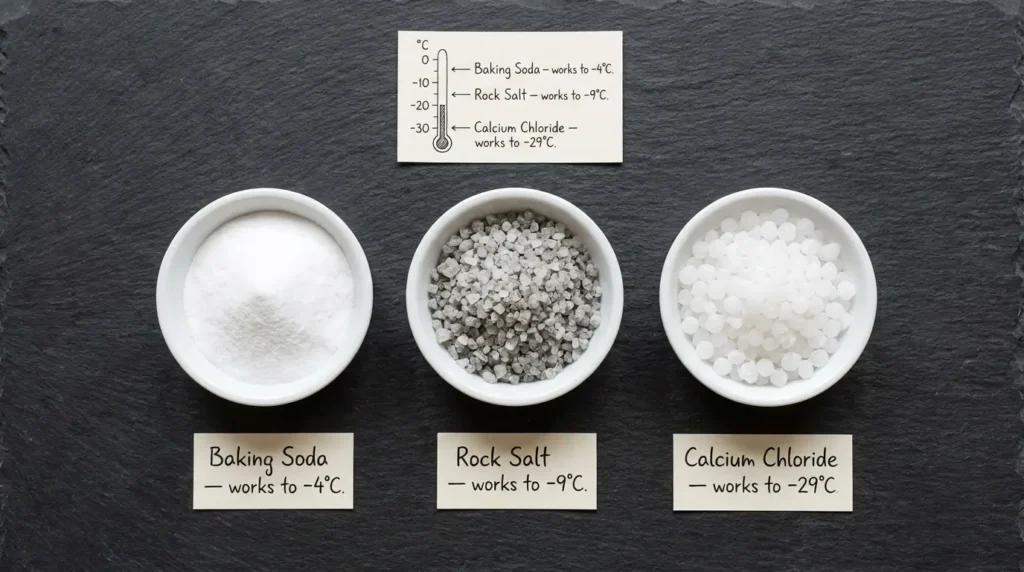
In practice, baking soda’s effective working range for ice melting is roughly 0°C to −4°C (32°F to 25°F). Below that, it provides traction but not meaningful melting. For a deeper look at sodium bicarbonate’s chemistry and how it behaves in water, the complete guide to what baking soda is covers the relevant properties.
Baking soda vs. rock salt: a direct comparison
| Baking soda (NaHCO₃) | Rock salt (NaCl) | Calcium chloride | |
|---|---|---|---|
| Effective temp range | 0°C to −4°C (32°F to 25°F) | 0°C to −9°C (15°F) | 0°C to −29°C (−20°F) |
| Melting speed | Slow to moderate | Moderate to fast | Fast |
| Concrete damage | Minimal | Moderate over time | Low to moderate |
| Plant / lawn damage | Low | Moderate to high | Moderate |
| Pet paw safety | Generally safe | Can irritate paws | Can irritate paws |
| Cost per application | Higher | Low | Higher |
| Availability | Universal | Universal | Hardware / garden stores |
The trade-off is clear: rock salt is cheaper and more effective at lower temperatures. Baking soda is gentler on surfaces, vegetation, and animals, and it’s already in most kitchens — making it a practical emergency option when salt isn’t on hand.
Why baking soda is sometimes the better choice
Concrete and pavement
Rock salt accelerates the freeze-thaw cycle in porous concrete — brine seeps into microcracks, refreezes, expands, and widens those cracks over repeated seasons. This is the primary reason salt is hard on driveways and sidewalks over time. Baking soda, applied at lower concentrations and with lower solubility, doesn’t penetrate porous surfaces as aggressively and causes less long-term structural damage.
If you’re managing a paved surface you care about — a new concrete driveway, a decorative stone path, a brick walkway — baking soda is noticeably gentler than salt for the same light-ice conditions.
Lawns, gardens, and planted areas
Sodium chloride runoff is toxic to most garden plants at the concentrations that accumulate after repeated winter applications — it disrupts osmotic balance in root cells and damages soil structure over seasons. Sodium bicarbonate is mildly alkaline rather than a salt ion source at harmful levels, and at the concentrations used for ice management it generally doesn’t cause the soil or plant damage associated with rock salt runoff. If your path borders a lawn, flower bed, or vegetable garden, the choice matters.
Pet safety
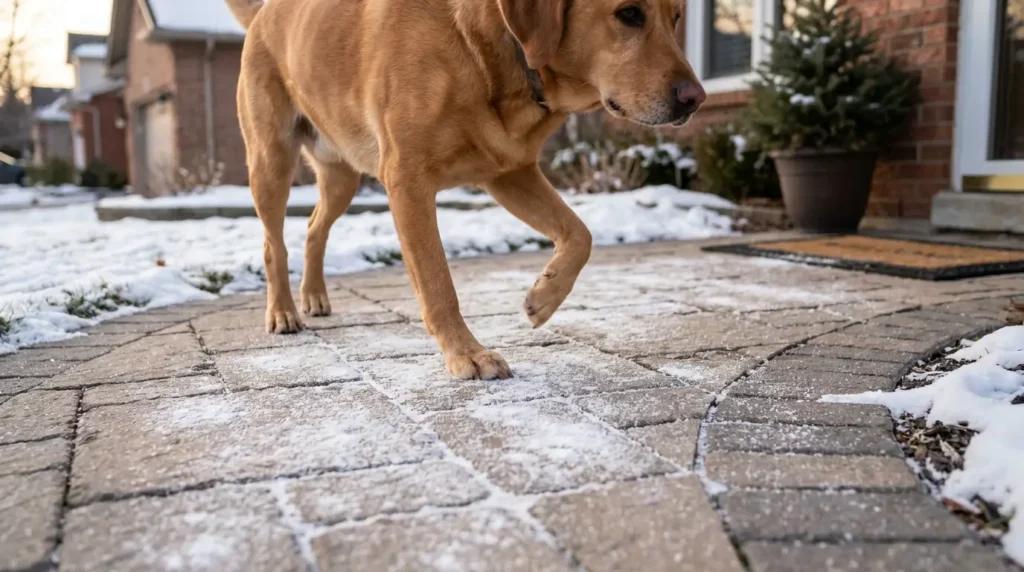
Rock salt and calcium chloride can cause paw irritation — cracked pads, chemical burns in severe cases — and GI upset if licked from paws. Baking soda is unlikely to cause either at typical application rates. It is safe to swallow in small amounts (it’s an FDA-approved food-grade ingredient) and doesn’t have the concentrated chloride ion chemistry that irritates tissues. For households with dogs that walk on treated surfaces and then lick their paws, baking soda is a meaningfully safer choice.
Emergency use from the kitchen
The most practical case: you have ice on your front steps this morning and no rock salt. A standard kitchen box of baking soda applied generously to the surface, worked in with a boot or brush, will loosen light ice at near-freezing temperatures in 10–20 minutes and provide immediate traction even before it starts melting. It won’t handle a thick ice sheet at −15°C, but for the common winter scenario — a thin glaze on steps at around freezing — it works.
How to apply baking soda for ice
The method is straightforward:
Step 1: Clear loose snow with a shovel before applying. Baking soda works on ice, not on snow — a layer of snow on top dilutes and insulates the application.
Step 2: Sprinkle baking soda generously and evenly over the iced surface. A light dusting isn’t enough — you need meaningful contact between the baking soda and the ice surface. For a typical front step (roughly 1 square metre), use 2–3 tablespoons spread evenly.
Step 3: Allow 10–20 minutes of contact time at temperatures near freezing. The baking soda will begin absorbing surface moisture, dissolve, and start breaking the bond between the ice and the pavement surface. The result is typically slush or loosened ice rather than complete melting — scrape with a shovel or brush after the initial contact period.
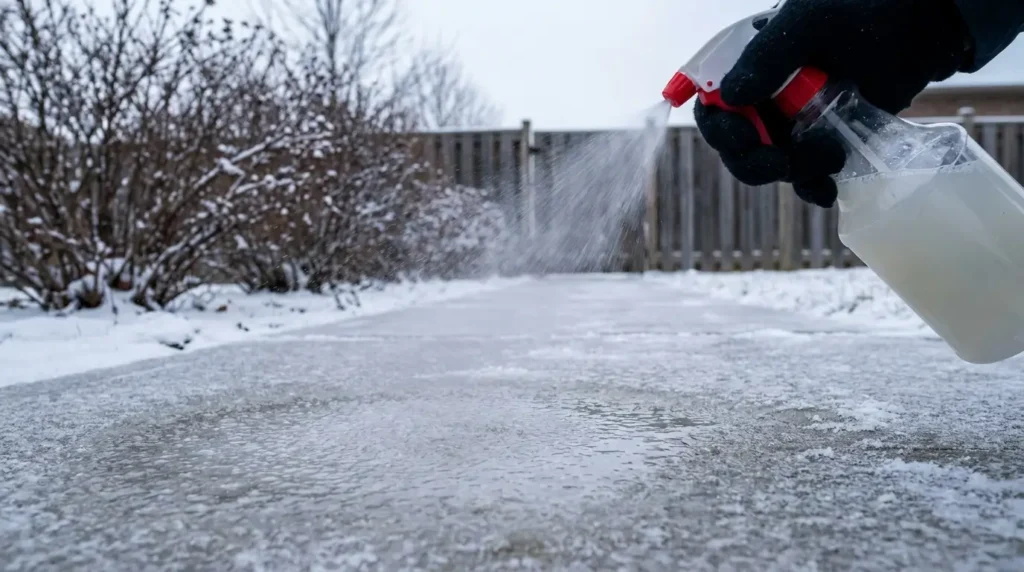
Step 4 (optional): For better performance, mix baking soda with warm water in a spray bottle (1–2 tablespoons per cup of warm water) and spray directly onto the ice surface. Applying it in solution speeds up the initial contact phase. This is more effective than dry application at temperatures just below freezing.
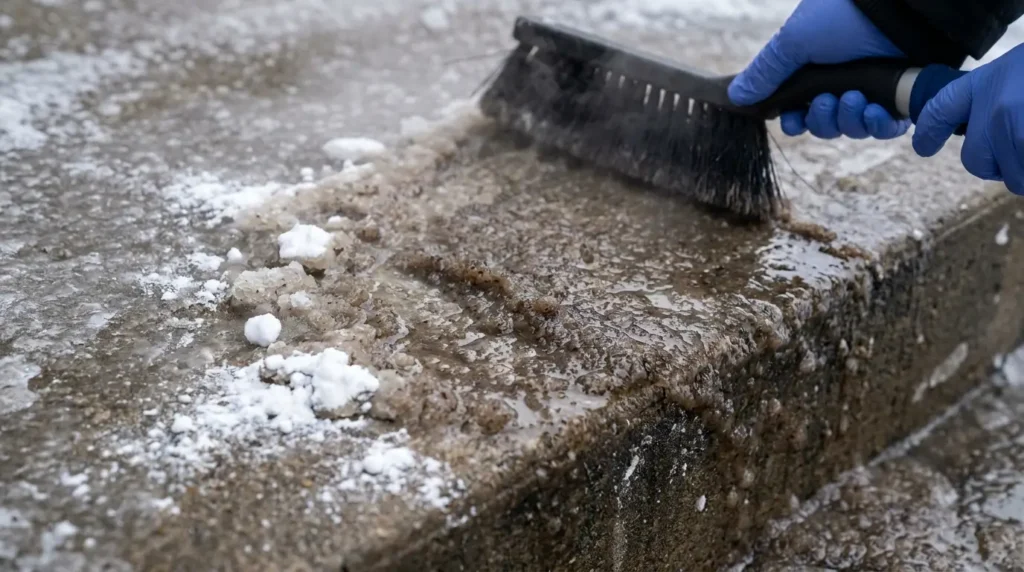
Temperature check: If the temperature is below −4°C (25°F), baking soda alone provides traction more than melting. At these temperatures, sprinkle dry baking soda for grip and plan on mechanical removal (scraping, shoveling) rather than waiting for chemical melting.
Does baking soda provide traction even when it doesn’t melt ice?

Yes — this is the underappreciated practical value of baking soda on ice. Even at temperatures below its effective melting range, baking soda granules on an icy surface function as an abrasive, providing grip underfoot the same way sand does. Unlike sand, baking soda will eventually dissolve and be absorbed without leaving grit residue that needs sweeping up in spring. And unlike salt, which provides no meaningful traction benefit as a dry solid (it needs to dissolve first to work), baking soda provides immediate physical traction the moment it hits the surface.
What baking soda doesn’t do well
To be clear about the limits:
It won’t melt a thick ice sheet at well below freezing. For a half-inch ice sheet at −10°C or colder, baking soda is insufficient. Calcium chloride or mechanical removal is the right tool.
It’s not economical at scale. Treating a long driveway with baking soda from kitchen boxes is expensive and slow. At scale, rock salt or a commercial ice melter is the practical choice. Baking soda makes most sense for targeted use: steps, door thresholds, short paths, pet areas.
It doesn’t work faster by adding more. Beyond a certain concentration in solution, additional solute doesn’t depress the freezing point further — the benefit plateaus. More baking soda doesn’t compensate for the temperature limitation.
Common questions
Can I mix baking soda and salt for better ice melting?
Yes — combining sodium bicarbonate with rock salt gives you the melting effectiveness of salt plus some reduction in the surface damage and paw-irritation concerns. The mixture isn’t dramatically better at melting than salt alone, but if you’re trying to stretch a limited salt supply or reduce the environmental impact of a full salt application, a 50/50 mix is a reasonable approach.
Does baking soda damage car paint or metal if it contacts vehicles?
Sodium bicarbonate is mildly alkaline but not corrosive to car paint, metal, or rubber at the concentrations used for ice treatment. The concern with road salt is the chloride ion, which accelerates rust in ferrous metals — baking soda doesn’t carry the same corrosion risk.
Is baking soda the same as baking powder for ice melting?
No. Baking powder contains baking soda plus dry acids and starch. The active ice-melting component in baking powder is its sodium bicarbonate fraction — roughly one-third by weight — and the rest doesn’t contribute to freezing point depression. Using baking powder for ice melting wastes the product and doesn’t improve performance. Use plain baking soda.
Baking soda is one of the more versatile items in the Basics cluster — a single compound that shows up in the kitchen, the cleaning cabinet, the medicine cabinet, and now the front steps. For the full picture of what sodium bicarbonate does across household contexts, the Basics hub is organized by use case and links to every article in the cluster.