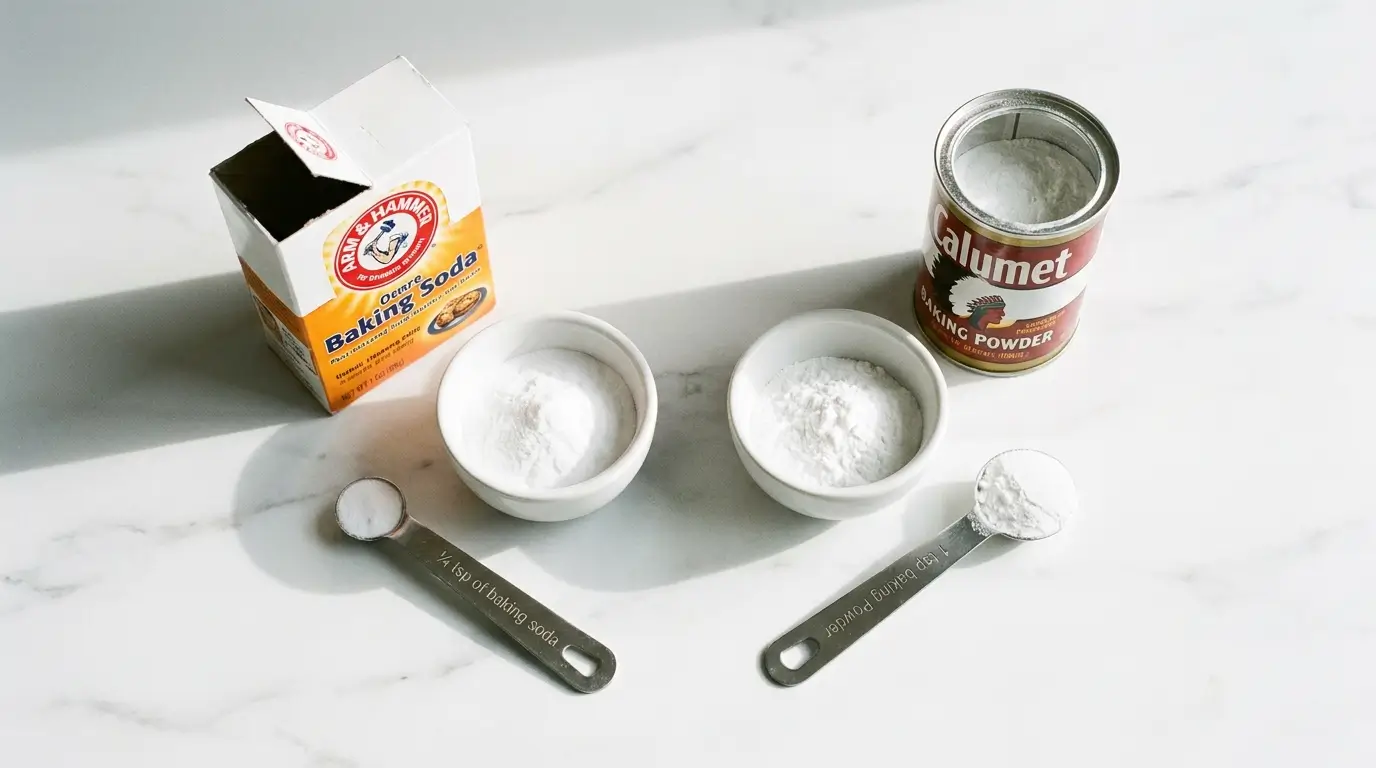
Baking soda and baking powder both make baked goods rise — but they are not the same product, they don’t work the same way, and swapping one for the other without adjusting the recipe almost always ends badly. One is a single pure chemical. The other is a blend. They need different conditions to activate, they affect flavor differently, and the ratio for substitution is never one-to-one.
This article explains the real difference between the two: what’s actually in each product, why recipes call for one or the other (or sometimes both), what happens to flavor and texture when you use the wrong one, and what to do when you’re out of one and need to substitute.
If you want to understand what baking soda is at the chemical level first, start with the complete guide to what baking soda is. This article builds directly on that foundation.
Table content
- 1 The one-sentence version
- 2 What’s actually in each product
- 3 Why recipes use one or the other — or both
- 4 Flavor implications: why this actually matters
- 5 How much of each does a recipe typically use?
- 6 Substitution: what actually works
- 7 What about “aluminum-free” baking powder?
- 8 Does baking powder expire faster than baking soda?
- 9 A practical cheat sheet
- 10 Common questions
- 11 The bottom line
The one-sentence version
Baking soda is pure sodium bicarbonate. It needs an acid in the recipe to work. Baking powder is sodium bicarbonate plus a powdered acid (and a starch buffer). It is self-activating — it just needs water and heat. That’s the whole difference. Everything else follows from it.
What’s actually in each product
Baking soda: one ingredient
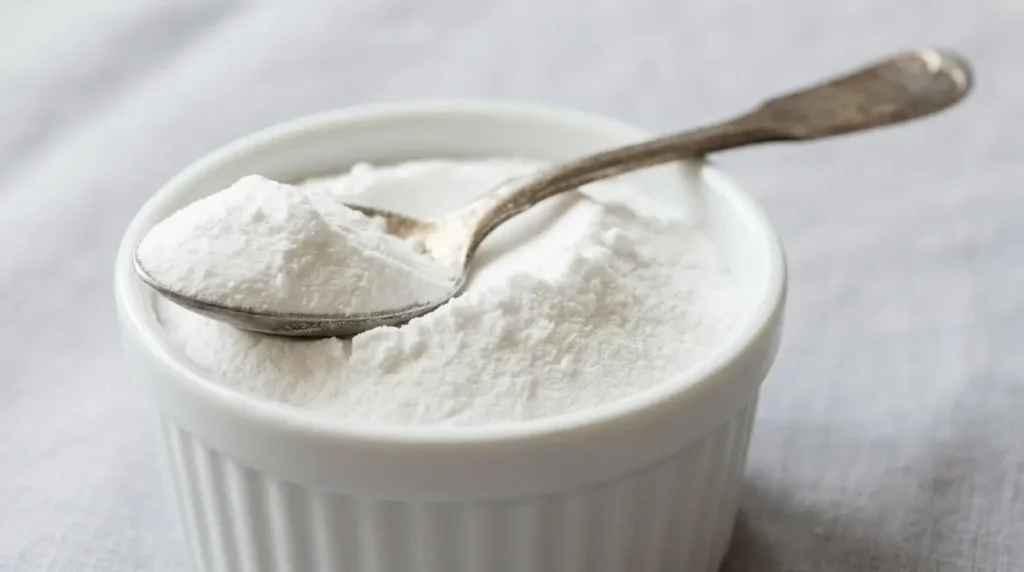
Baking soda is sodium bicarbonate — chemical formula NaHCO₃ — and nothing else. There are no additives, no buffers, no acids. The box contains a single compound.
Because baking soda is a base (alkaline, pH around 8.3 in water), it cannot produce carbon dioxide on its own in a cold batter. It needs an acid to react with. When it finds one — buttermilk, sour cream, lemon juice, vinegar, yogurt, brown sugar, molasses, natural cocoa, honey — the reaction is immediate:
NaHCO₃ + H⁺ → Na⁺ + H₂O + CO₂↑
The CO₂ bubbles expand in the oven, lifting the batter. This is fast-acting leavening: much of the gas is produced as soon as the wet and dry ingredients combine, which is one reason quick bread batters should go straight into the oven — waiting around lets those bubbles escape before the structure sets.
Baking powder: a three-part blend
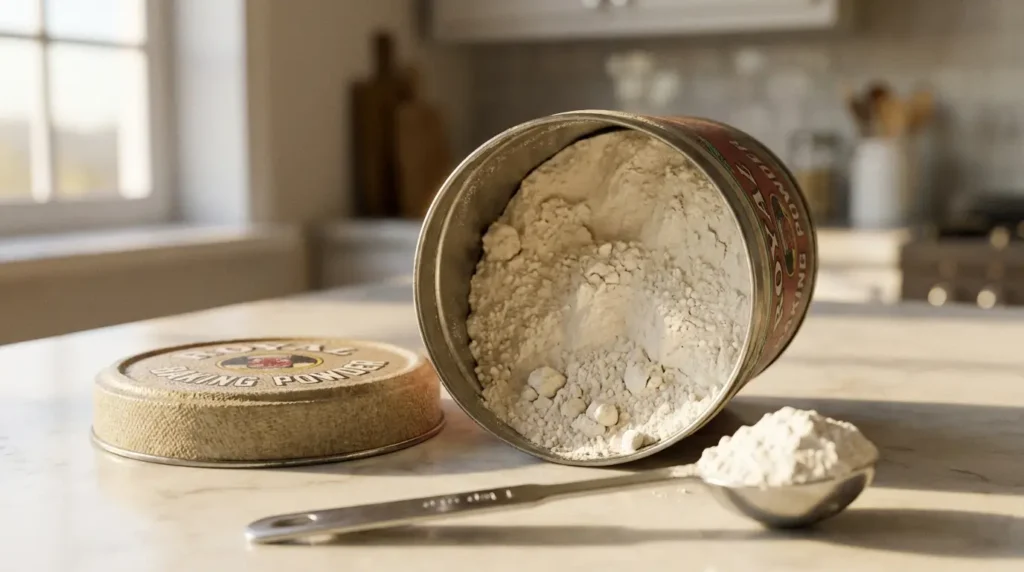
Baking powder contains three things:
- Sodium bicarbonate — the leavening agent, same as in baking soda
- A dry acid — typically cream of tartar, monocalcium phosphate, sodium aluminum sulfate, or sodium acid pyrophosphate, depending on the brand
- A starch buffer — usually cornstarch, which absorbs moisture and prevents the acid and base from reacting prematurely in the container
Because the acid is already present inside the powder, baking powder activates the moment it touches moisture — no additional acidic ingredient required. In most modern double-acting baking powders (which is what you find on nearly every US grocery shelf), there are actually two separate acids: one that reacts at room temperature when the batter is mixed, and a second that reacts only at oven temperatures. The result is two rounds of gas production — one early, one late in the bake — giving the baker a wider window before the batter has to be in the oven.
Why recipes use one or the other — or both
Recipes that use only baking soda
These recipes provide all the acid the baking soda needs from their own ingredients. Classic examples:
- Buttermilk pancakes — the buttermilk is acidic enough to react with the baking soda and neutralize it completely
- Irish soda bread — buttermilk again, which is the defining ingredient
- Banana bread — ripe bananas are moderately acidic, and many recipes also include yogurt or brown sugar
- Classic chocolate chip cookies — brown sugar and (in some formulations) natural cocoa provide the acid
The key principle: if the recipe has enough acid to fully consume the baking soda, no baking powder is needed. The goal is complete reaction — any unreacted sodium bicarbonate decomposes in the oven’s heat into sodium carbonate, which leaves a faintly soapy, metallic aftertaste. A well-balanced recipe avoids this.
Recipes that use only baking powder
These recipes have no (or insufficient) acidic ingredients, so there’s no available acid for baking soda to react with. Baking powder brings its own. Common examples:
- Classic yellow cake — made with whole milk, which is nearly neutral (pH ~6.7)
- Vanilla sponge — similarly neutral batter
- Scones (British style) — made with cream, not buttermilk
- Blueberry muffins in many formulations
Recipes that use both
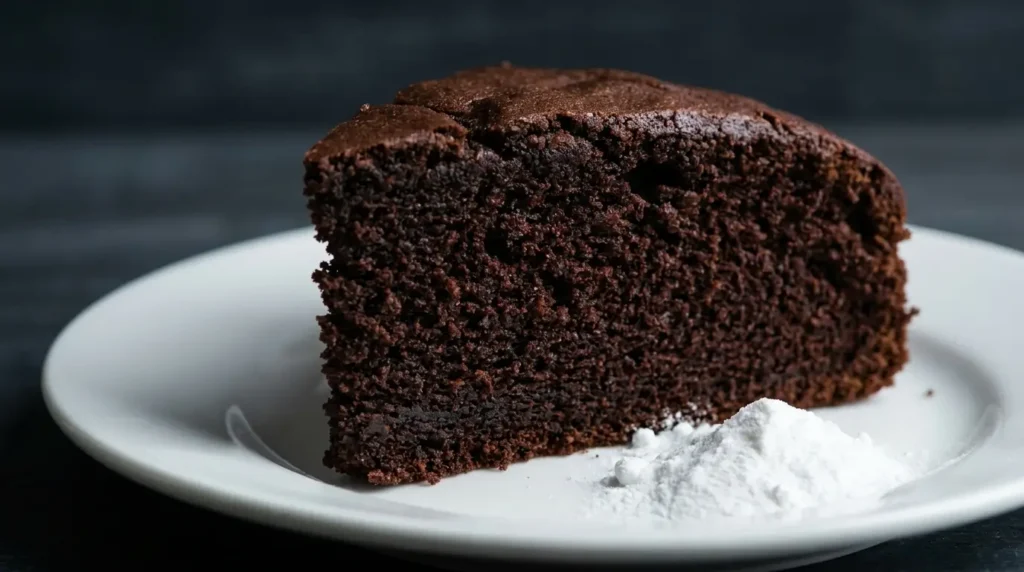
This is the combination that confuses people most. If baking powder already contains baking soda, why add extra?
Two reasons:
1. The recipe needs more leavening than baking powder alone can provide. Baking powder is only about one-third sodium bicarbonate by weight. A large, dense batter (like a double-chocolate layer cake) may need more lift than a reasonable amount of baking powder can generate on its own.
2. The recipe uses an acidic ingredient for flavor and texture, not just for leavening. When buttermilk, yogurt, or natural cocoa appears in a recipe that already calls for baking powder, the baking soda is there to neutralize the excess acid, controlling the final flavor and affecting browning (alkalinity encourages the Maillard reaction). The baking powder handles the bulk of the leavening.
A classic example is devil’s food cake: natural cocoa is quite acidic, the recipe wants depth of flavor and dramatic color from the cocoa, and it needs serious lift. The solution is baking powder for reliable leavening plus baking soda to neutralize the cocoa’s acidity and intensify the chocolate color.
Flavor implications: why this actually matters
Using the wrong leavener doesn’t just affect rise — it affects taste.
Too much unreacted baking soda produces a soapy or faintly metallic aftertaste. You’ve almost certainly noticed this in a muffin where the recipe was off or someone doubled the baking soda by mistake. The culprit is sodium carbonate, the byproduct of baking soda decomposing in heat without an acid to neutralize it.
Baking powder in a recipe that calls for baking soda usually means you’re diluting the acid-base reaction that was supposed to happen. If the recipe relied on that reaction to neutralize the acid (say, buttermilk), the final product may taste slightly more sour than intended — and may not brown as well, since Maillard browning is accelerated by alkalinity.
Baking soda in a recipe that calls for baking powder — and where there’s no acid in the batter — means the baking soda can’t properly activate. You get less rise and potentially the soapy aftertaste problem.
How much of each does a recipe typically use?
As a general benchmark:
- Baking soda: approximately ¼ teaspoon per 1 cup of flour, when the recipe has adequate acid. Higher amounts risk aftertaste.
- Baking powder: approximately 1 teaspoon per 1 cup of flour, give or take depending on batter density and desired rise.
These are starting points, not rigid rules. Professional bakers adjust based on the specific acid content of their ingredients, the hydration of the batter, and the desired texture. But these benchmarks are useful for troubleshooting a recipe that feels like it has the leavening wrong.
Substitution: what actually works
Substituting baking powder when you only have baking soda
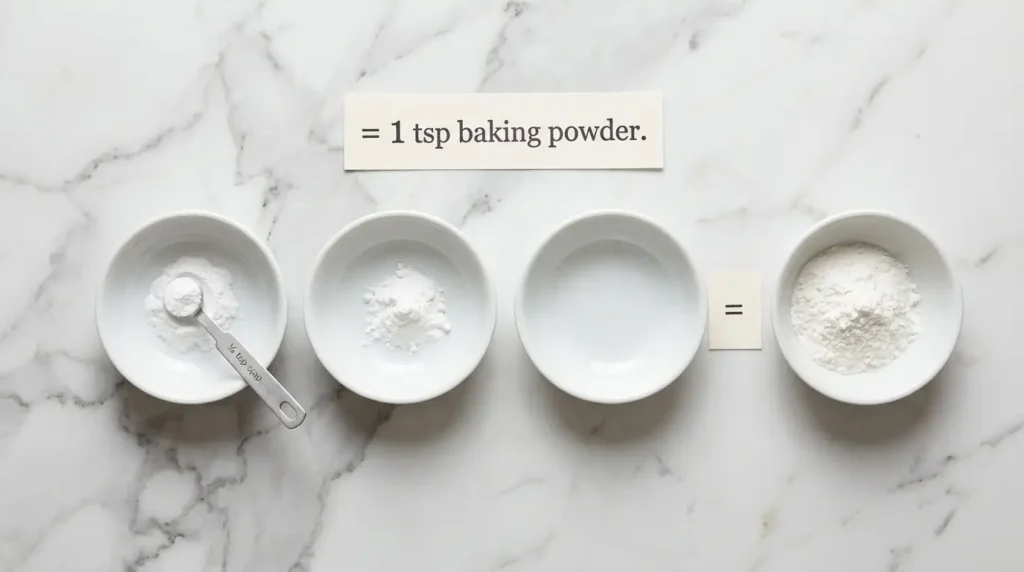
Baking powder is roughly one-third sodium bicarbonate, so to replace 1 teaspoon of baking powder, you need:
- ¼ teaspoon baking soda + ½ teaspoon cream of tartar (the most reliable substitute — cream of tartar is the dry acid, and the ratio mirrors how baking powder is formulated)
- ¼ teaspoon baking soda + ½ cup plain yogurt or buttermilk (reduce another liquid in the recipe by the same amount to maintain hydration)
- ¼ teaspoon baking soda + ½ teaspoon lemon juice or white vinegar (fast-reacting — get the batter in the oven quickly)
The cream of tartar method is the cleanest because it adds no extra liquid and the ratio is precise.
Substituting baking soda when you only have baking powder
To replace 1 teaspoon of baking soda, you need approximately 3 teaspoons (1 tablespoon) of baking powder. That’s a large volume swap and it comes with trade-offs:
- Tripling the baking powder can introduce a faintly metallic or tinny flavor from the acid salts in the powder, especially noticeable in lightly flavored batters like vanilla cake.
- It also adds sodium from the additional baking powder, which can affect taste.
- And it may over-leaven — not all that extra gas is useful rise; some produces a crumbly or uneven crumb.
In practice, this substitution works adequately in strongly flavored batters (chocolate, spice cake, banana bread) where the extra acid-salt flavor disappears into the overall profile. In delicate recipes, you’ll notice.
For more detailed ratios and additional options — including self-rising flour and whipped egg whites — see the complete baking soda substitute guide.
What about “aluminum-free” baking powder?
Many baking powders use sodium aluminum sulfate as one of their acid components, particularly for the second-stage (heat-activated) reaction. Some bakers dislike the slight mineral aftertaste that aluminum-based acid compounds can produce in very lightly flavored baked goods.
Aluminum-free baking powders replace the aluminum salt with alternatives like sodium acid pyrophosphate or cream of tartar. Popular options in the US include Rumford (cream of tartar-based) and Bob’s Red Mill.
Worth noting: baking soda contains no aluminum — the “aluminum-free” confusion sometimes bleeds over from baking powder to baking soda. If you’ve seen “aluminum-free” on a baking soda label, that’s a marketing claim about something that was never there in the first place.
Does baking powder expire faster than baking soda?
Yes — and the gap is meaningful.
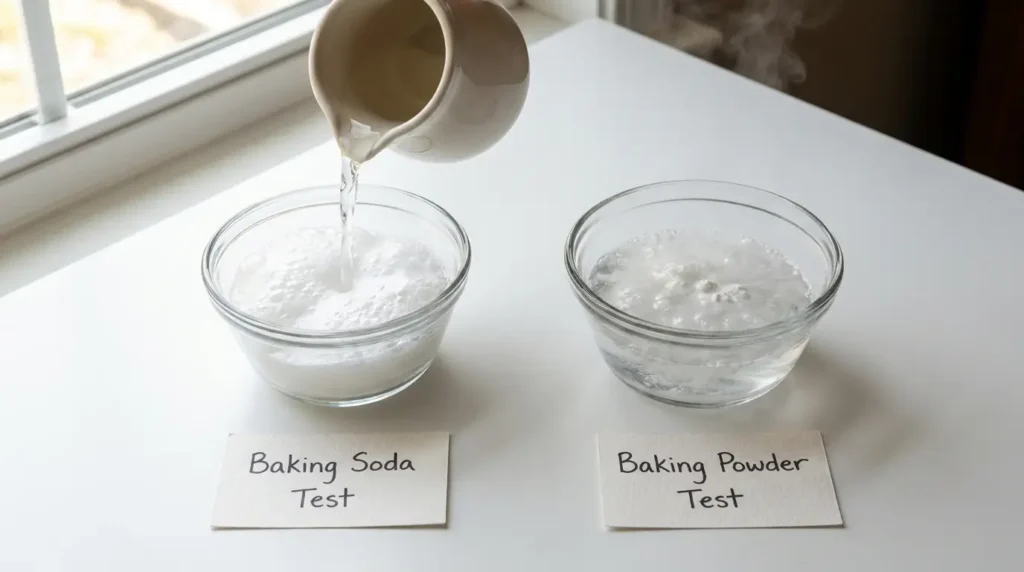
Baking soda is a single stable compound. Stored dry and sealed, it lasts years beyond its printed date, though an open box left in a humid kitchen will gradually lose potency. The standard test: drop half a teaspoon into a tablespoon of vinegar. Immediate vigorous fizzing means it’s still active.
Baking powder is less stable because it contains both an acid and a base in the same container, separated only by a starch buffer. Any moisture infiltration starts the reaction prematurely, and the leavening power degrades. Most baking powders are reliably active for about 6–12 months after opening. The freshness test: drop half a teaspoon into hot (not cold) water. Vigorous fizzing means it’s still good; a slow bubble or no reaction means it’s time to replace it.
An easy way to remember it: baking soda ages like a salt (slowly); baking powder ages like a spice blend (faster).
For a full breakdown of shelf life, storage tips, and freshness tests for both, see does baking soda expire.
A practical cheat sheet
| Baking Soda | Baking Powder | |
|---|---|---|
| What it is | Pure sodium bicarbonate (NaHCO₃) | NaHCO₃ + dry acid + starch |
| Needs acid to activate? | Yes | No (acid is built in) |
| Typical use rate | ¼ tsp per cup flour | 1 tsp per cup flour |
| Flavor risk | Soapy/metallic if not neutralized | Metallic if used in excess |
| Shelf life (opened) | 1–3 years | 6–12 months |
| Freshness test | + vinegar → fizz | + hot water → fizz |
| To replace 1 tsp baking powder | ¼ tsp + ½ tsp cream of tartar | — |
| To replace 1 tsp baking soda | — | 3 tsp baking powder (with trade-offs) |
Common questions
Can I use baking powder instead of baking soda in banana bread?
Technically yes, at three times the volume, but banana bread’s flavor depends partly on the acid-base reaction between baking soda and the natural acids in ripe bananas. The baking-powder version tends to taste flatter and browns less dramatically. It’ll still rise — it just won’t taste as good.
Why does my recipe use both — isn’t that redundant?
No. As explained above, each is usually doing a different job: baking powder for leavening, baking soda for neutralizing excess acid and improving browning. It’s intentional.
My recipe uses buttermilk and calls for both. Can I cut the baking soda?
Only if you also adjust the baking powder upward. The baking soda in that recipe is paired with the buttermilk’s acidity; cutting the soda leaves excess acid in the batter, which changes the flavor and may inhibit browning.
Is baking powder just baking soda mixed with cream of tartar?
That’s close to the homemade version, yes — but commercial baking powders often use two acids (one room-temperature-reactive, one heat-reactive) to create the double-acting effect. A homemade mix of baking soda and cream of tartar is single-acting: it reacts immediately and there’s no second hit in the oven. For most home baking this is fine; for anything that needs to hold its structure in the oven without collapsing (like a soufflé or a delicate chiffon cake), the double-acting timing matters.
Are there recipes that use neither?
Yes. Yeast breads, croissants, puff pastry, and choux pastry get their lift from yeast fermentation, steam, or beaten air — no chemical leavener involved. Some older recipes use beaten egg whites or whipped cream as the sole leavener. Baking soda and baking powder are specifically the tools of quick breads — products leavened by a chemical gas-producing reaction rather than a biological or mechanical one.
The bottom line
The difference between baking powder and baking soda comes down to one thing: whether the acid is already in the container. Baking soda is a base — powerful but reactive and dependent on the recipe’s other ingredients. Baking powder is a complete system — predictable, self-contained, and more forgiving of recipe variations. Most baking failures that get blamed on technique are actually a leavener mismatch: the wrong product, the wrong amount, or a box that’s past its prime.
Get this one right and a large class of “why didn’t this rise?” problems disappears.
From here:
- What is baking soda? — the chemical and practical foundation
- Baking soda substitute guide — full ratios for every common substitute
- Baking soda pH and chemistry — if you want to understand the acid-base reactions in more depth
- Classic Irish soda bread recipe — a recipe where getting the soda-to-buttermilk ratio exactly right is the whole game
- Banana bread with baking soda — another recipe where understanding leavener chemistry improves the result