
If you’ve ever wondered exactly how alkaline that box of baking soda in your fridge really is, here’s the short answer: a solution of baking soda sits at roughly pH 8.3 — mildly basic, but nowhere near the “harsh chemical” reputation it sometimes gets. For comparison, that’s closer to the pH of seawater (around 8.1) than it is to ammonia or oven cleaner.
The number itself is only half the story, though. What’s genuinely useful — whether you’re troubleshooting a recipe, mixing up a cleaning solution, or just curious about what’s in your pantry — is understanding why that pH holds so steady, and what’s actually happening at the molecular level when baking soda meets heat, water, or an acid. That’s what this article digs into: the formula, the chemistry behind the number, and what it means once you’re standing in the kitchen.
Table content
- 1 What Baking Soda Actually Is (and What “Formula” Means Here)
- 2 So What Does a pH of 8.3 Actually Mean?
- 3 Why the pH Barely Changes, No Matter How Much You Use
- 4 One Formula, Two Jobs: Why Bicarbonate Is “Amphiprotic”
- 5 What Happens When You Heat Baking Soda
- 6 Where This Shows Up: Baking, Cleaning, and More
- 7 Baking Soda vs. Baking Powder: A pH Difference, Not Just a Naming One
- 8 Where Baking Soda Sits on the Household pH Scale
- 9 Does Baking Soda’s pH Change as It Sits on the Shelf?
- 10 The Bottom Line
What Baking Soda Actually Is (and What “Formula” Means Here)
Baking soda’s chemical name is sodium bicarbonate, and its formula is written as NaHCO₃ — one sodium ion (Na⁺) paired with one bicarbonate ion (HCO₃⁻). It’s a white, fine crystalline powder with a molar mass of about 84.01 g/mol, and chemists identify it by the CAS number 144-55-8. If you want to see the raw data sheet, PubChem’s entry for sodium bicarbonate is the standard reference.
That bicarbonate ion is the part that does almost all the interesting chemistry. It’s a weak base — not a strong one — and that distinction is the main reason baking soda behaves so differently from something like lye (sodium hydroxide, NaOH), even though both are technically “basic.” Sodium hydroxide is a strong base that dissociates almost completely in water; bicarbonate only partially reacts with water, which caps how alkaline it can get.
One practical note tied to the formula: sodium bicarbonate dissolves better in warm water than cold. Solubility runs from around 69 grams per liter near freezing to roughly 165 grams per liter at 60°C (140°F). If a recipe or cleaning mix calls for fully dissolving baking soda rather than just suspending it in liquid, warm water gets you there faster.
For the bigger picture — including how it’s produced and how it relates to other forms of sodium — see our complete guide to what baking soda is.
So What Does a pH of 8.3 Actually Mean?

pH is a logarithmic scale running from 0 to 14 that measures how acidic or basic a water-based solution is. Seven is neutral — that’s pure water. Anything below 7 is acidic; anything above 7 is basic (alkaline). Because the scale is logarithmic, each whole-number step represents a tenfold change in hydrogen-ion concentration: a solution at pH 6 is ten times more acidic than one at pH 7, and a solution at pH 8 is ten times more basic than pH 7.
At 8.3, baking soda sits just above neutral — mildly alkaline. For perspective, human blood normally runs around pH 7.35–7.45, and seawater is typically close to 8.1. Baking soda lives in that same gentle range. It’s a long way from the pH 12–13 territory of ammonia or chlorine bleach, and an even longer way from the pH 0–1 of battery acid. “Basic” doesn’t have to mean “caustic,” and baking soda is a useful example of that distinction.
Why the pH Barely Changes, No Matter How Much You Use
Here’s the detail most explanations skip, and it’s the most useful one: the pH of a baking soda solution doesn’t shift much whether you dissolve a pinch or a tablespoon into a cup of water. That’s not a coincidence — it’s a direct result of how the bicarbonate ion behaves chemically.
Bicarbonate sits in the middle of a two-step acid-base relationship. On one side, carbonic acid (H₂CO₃) can lose a hydrogen ion to become bicarbonate (HCO₃⁻) — that transition happens around a pKa of roughly 6.3. On the other side, bicarbonate can lose another hydrogen ion to become carbonate (CO₃²⁻) — that transition happens around a pKa of roughly 10.3.
When a weak acid or base sits roughly halfway between two such transition points, the resulting pH tends to settle near the average of those two pKa values — in this case, right around (6.3 + 10.3) ÷ 2 ≈ 8.3. That’s the buffering effect at work: bicarbonate resists large pH swings because it’s chemically “anchored” between those two equilibria, rather than free to keep shifting as you add more of it.
In practice, real-world measurements of baking soda solutions are reported anywhere from about pH 8.0 to 8.5, depending on concentration, water purity, temperature, and how much dissolved carbon dioxide is in the water. That’s a narrow band — not the dramatic swing you’d see with a strong acid or strong base, where concentration changes the pH a great deal. It’s also why baking soda functions as a reasonably effective mild buffer in DIY applications: it nudges a solution toward ~8.3 and then resists moving much further.
One Formula, Two Jobs: Why Bicarbonate Is “Amphiprotic”

There’s a reason baking soda shows up in such different contexts — neutralizing spilled acid, settling an upset stomach, helping bread rise. The bicarbonate ion is amphiprotic, meaning it can act as either an acid or a base depending on what it’s reacting with.
When bicarbonate meets something more acidic than itself — vinegar, lemon juice, stomach acid — it acts as a base, accepting a hydrogen ion. The resulting carbonic acid (H₂CO₃) is unstable and immediately breaks down into water and carbon dioxide gas, which is the fizz you see in almost every classic “baking soda and vinegar” reaction.
When bicarbonate meets something more basic than itself, it can in principle act as a weak acid, donating a hydrogen ion to form carbonate (CO₃²⁻). In everyday kitchen and household chemistry, though, you’ll overwhelmingly see bicarbonate playing the base role — the acid-accepting, CO₂-releasing reaction is the one that matters for nearly every common use.
What Happens When You Heat Baking Soda
Heat changes baking soda’s chemistry in a way that matters for both baking and for understanding its pH. When sodium bicarbonate is heated — starting at around 50°C (122°F) and becoming more complete at typical oven temperatures — it decomposes according to this reaction:
2 NaHCO₃ → Na₂CO₃ + H₂O + CO₂
The products are sodium carbonate (washing soda), water, and carbon dioxide gas. That released CO₂ is exactly what makes baked goods rise: the gas gets trapped in batter or dough, expands with heat, and creates the air pockets that give cakes, pancakes, and quick breads their texture.
The other product, sodium carbonate, is noticeably more alkaline than baking soda itself — solutions of washing soda run around pH 11, compared to baking soda’s ~8.3. This is the chemistry behind a common baking complaint: when a recipe uses more baking soda than there’s acid available to react with, the leftover sodium carbonate pushes the batter’s pH higher than intended. That extra alkalinity is what produces a soapy or metallic aftertaste, and it also accelerates Maillard browning — which is why over-soda’d baked goods often come out with an unusually dark crust.
Where This Shows Up: Baking, Cleaning, and More
In Baking
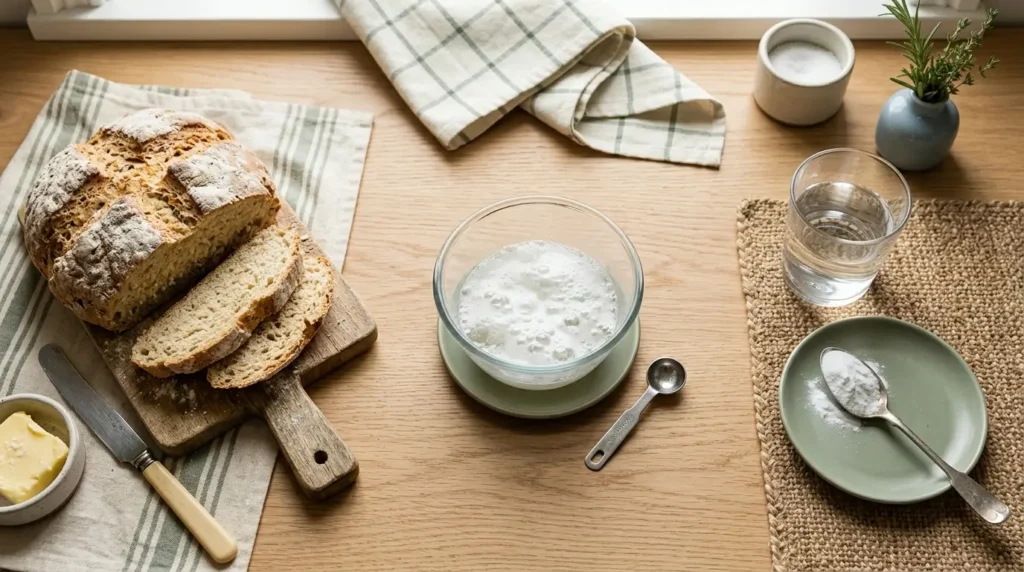
In baking, the chemistry above is the whole story: an acid (buttermilk, yogurt, brown sugar, citrus, cocoa, vinegar) reacts with baking soda to release CO₂ on contact, while the oven’s heat triggers further decomposition for additional lift. Recipes that lean on this acid-soda pairing — rather than the slower-acting acid built into baking powder — tend to start rising earlier and develop their crumb sooner in the bake.
Irish soda bread is the textbook example: no yeast, no baking powder, just baking soda reacting with the lactic acid in buttermilk. See our classic Irish soda bread recipe to see that reaction at work in a real dough.
In Cleaning
For cleaning, the relevant reaction is the same acid-base neutralization, just applied to grease, odors, and stains instead of batter. Mixing baking soda with vinegar produces sodium acetate, water, and CO₂ — the fizzing reaction behind every DIY drain “volcano.” The fizzing itself doesn’t do much of the actual cleaning; it’s largely the mild abrasiveness of the bicarbonate crystals and the mild alkalinity (pH ~8.3) cutting through acidic grime that does the work. For a closer look at what’s actually happening in that reaction — and when it’s worth reaching for — see our breakdown of baking soda and vinegar.
As an Antacid
The same acid-neutralizing chemistry is why sodium bicarbonate is a recognized over-the-counter antacid: it reacts with hydrochloric acid in the stomach (HCl) to form sodium chloride, water, and CO₂ — which is also why it’s associated with burping after use. How much to use, how often, and whether it’s appropriate for your situation are questions for a doctor or pharmacist, not a chemistry article. If you’re curious about the evidence specifically around heartburn and acid reflux, we cover that in more detail in our look at baking soda and acid reflux.
Baking Soda vs. Baking Powder: A pH Difference, Not Just a Naming One
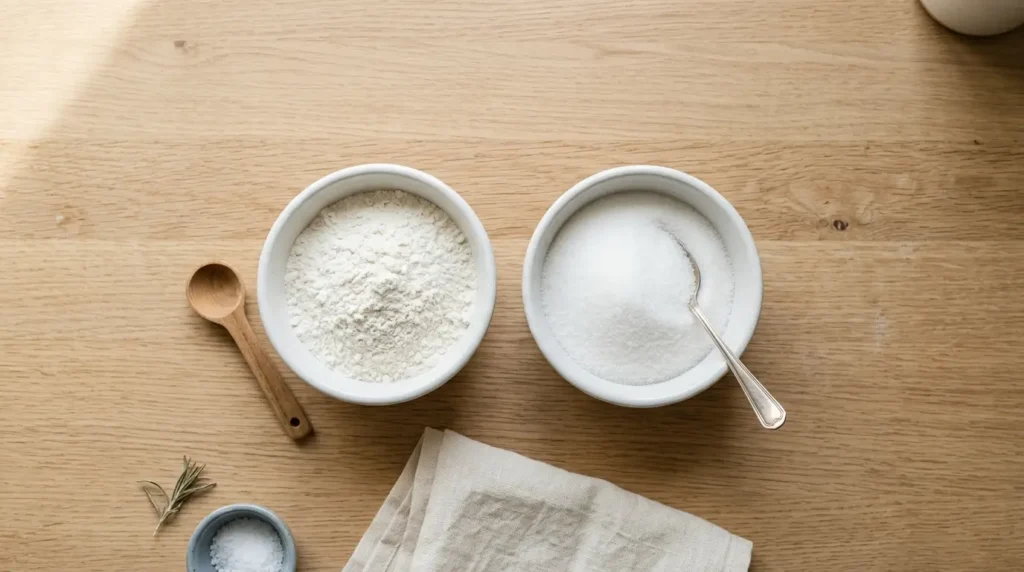
Baking soda and baking powder are often used interchangeably in casual conversation, but they’re chemically different products — and the difference comes down to pH.
Baking soda is pure sodium bicarbonate: a base with nothing to react against until it meets an acid from elsewhere in the recipe — buttermilk, yogurt, molasses, brown sugar, vinegar, citrus. On its own, a baking soda solution sits at that ~8.3 pH discussed above.
Baking powder is baking soda plus a powdered acid (commonly cream of tartar, or sodium aluminum sulfate in some formulations) plus a starch — usually cornstarch — that keeps the two apart and absorbs moisture until they’re needed. Because the acid is already built in, baking powder can leaven a recipe with no other acidic ingredients at all. A baking powder solution, with its acid and base largely neutralizing each other, tends to land much closer to neutral (around pH 7) than a baking soda solution does.
That pH difference is also part of why the two aren’t interchangeable in equal amounts — the ratio of available acid to base changes the math. For the full substitution guidance and when each one is the right call, see our detailed comparison of baking powder and baking soda.
Where Baking Soda Sits on the Household pH Scale
Numbers are easier to use when you have something to compare them to. Here’s where a baking soda solution (~8.3) falls relative to other common substances:
| Substance | Approximate pH |
|---|---|
| Battery acid | 0–1 |
| Lemon juice | ~2 |
| White vinegar | ~2.5 |
| Black coffee | ~5 |
| Pure water | 7 (neutral) |
| Baking soda solution | ~8.3 |
| Washing soda (sodium carbonate) solution | ~11 |
| Household ammonia | ~11–12 |
| Chlorine bleach | ~12.5–13 |
A couple of things stand out here. First, baking soda is genuinely mild — it sits about as far from neutral as black coffee does, just on the opposite side of the scale. Second, the gap between baking soda (~8.3) and its heated byproduct, washing soda (~11), is bigger than the 2.7-point difference suggests: because pH is logarithmic, that gap represents something like a few-hundred-fold increase in hydroxide-ion concentration — a good reminder that small differences in pH can mean large differences in actual chemical strength.
Does Baking Soda’s pH Change as It Sits on the Shelf?
Short answer: not really, as long as it’s stored properly — though the related question of whether baking soda “still works” is a bit more nuanced.
Dry, sealed sodium bicarbonate is a fairly stable compound at room temperature. It doesn’t spontaneously convert to washing soda the way it does when heated, so an unopened box doesn’t gradually become more alkaline just sitting on a shelf. What can happen over time — especially once a container is open — is that the powder absorbs moisture and odors from the air, and in humid conditions, slow exposure to ambient moisture and carbon dioxide can nudge a small surface fraction toward the same kind of conversion that heat accelerates. That’s a slow, surface-level effect, not a dramatic pH shift.
The more practical question for most people is whether baking soda still has enough reactive “punch” left for leavening — which is a different test than measuring pH. For how to check that, and how to store baking soda so it lasts, see our guide on whether baking soda expires.
The Bottom Line
- Baking soda’s formula is NaHCO₃ (sodium bicarbonate) — one sodium ion paired with one bicarbonate ion.
- A baking soda solution sits at roughly pH 8.3, mildly alkaline — closer to seawater than to ammonia or bleach.
- That pH barely moves with concentration, because bicarbonate sits almost exactly between two acid-base equilibria (pKa ~6.3 and ~10.3), buffering the solution near their average.
- Bicarbonate is amphiprotic — it can act as a weak acid or a weak base, though everyday uses almost always rely on the acid-neutralizing, CO₂-releasing base reaction.
- Heat converts it to washing soda (Na₂CO₃, pH ~11), releasing the CO₂ that makes baked goods rise — and explaining why too much baking soda leaves a soapy aftertaste and a darker crust.
Once the chemistry clicks, the rest is application. If you’re looking for ways to put sodium bicarbonate’s mild alkalinity and acid-neutralizing ability to work around the house, our 100 uses for baking soda is a good place to go next.